ICE STUPAS: Turning Winter Cold into Summer Water
A Community-Led Cli
mate Adaptation Solution for the High Mountains of Gilgit-Baltistan
In the high mountains of Gilgit-Baltistan, Pakistan, water is life—and for many mountain communities, access to water is becoming increasingly uncertain due to changing snowfall patterns, glacier retreat, rising temperatures, and climate-related water stress.
To respond to this challenge, Youth Action for Next Generations (YANG) is promoting and implementing ICE Stupas—a locally adapted, nature-based water conservation approach that uses the freezing winter temperatures of the high mountains to store water in the form of artificial ice glaciers.
The concept is simple: store winter water as ice so that it can gradually provide water when communities need it most.
What is an ICE Stupa?
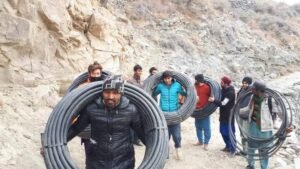
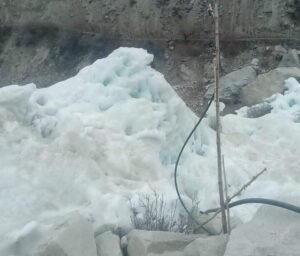
An ICE Stupa is an artificial ice formation created by allowing water to freeze naturally during the cold winter months. Water from a suitable source is transported through a pipeline to a higher point, where it is released into the freezing atmosphere.
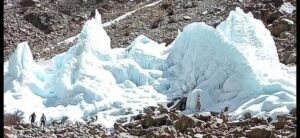
Because temperatures in the high mountains can remain well below freezing during winter, the water freezes and gradually forms a large cone-shaped ice structure.
As temperatures rise in spring and summer, the stored ice melts naturally, providing an additional source of water for communities, agriculture, plantations, and ecosystems during the critical dry season.
Why ICE Stupas Matter in Gilgit-Baltistan
Gilgit-Baltistan is home to some of the world’s highest mountains and glaciers, but mountain communities are increasingly experiencing changes in water availability.
Climate change is affecting the timing and reliability of snowfall, glacier melt, precipitation, and spring water. In many valleys, communities depend heavily on meltwater and springs for drinking water, agriculture, livestock, and other daily needs.
The challenge is particularly serious in high-altitude and remote communities where conventional water-storage infrastructure can be expensive, difficult to construct, or difficult to maintain.
ICE Stupas offer a locally appropriate adaptation option by using something the mountains naturally provide in abundance during winter: extreme cold.
How the YANG ICE Stupa Model Works
YANG’s approach focuses on combining traditional community knowledge, youth participation, locally available resources, and climate adaptation.
1. Identify a suitable water source
The first step is to identify a reliable winter water source and assess the surrounding terrain, elevation, accessibility, and community needs.
2. Transport water to a higher elevation
Water is transported through a pipeline toward a higher location where winter temperatures are sufficiently low for natural freezing.
3. Natural freezing
At the outlet, water is released into the cold winter air. The water freezes layer by layer, gradually creating a large ice structure.
4. Community stewardship
Local community members participate in monitoring, maintenance, and protection of the ICE Stupa site.
5. Summer water release
During warmer months, the accumulated ice gradually melts and contributes to water availability during the agricultural and dry seasons.
From an Idea to Action
YANG began exploring and testing the ICE Stupa approach in the Siachen Valley of Gilgit-Baltistan, a high-altitude mountain environment where communities face significant seasonal water challenges.
The initiative was first built and tested in 2025, demonstrating the potential of using the region’s extreme winter conditions for water storage.
The experience has also helped YANG identify the importance of seasonal planning. Because ICE Stupas depend on freezing temperatures, their construction is primarily a winter activity, while the warmer months are better suited for community engagement, youth learning, monitoring, and site visits.
Youth at the Centre of Climate Adaptation
YANG believes that climate adaptation should not only be designed for mountain communities—it should be developed with them, particularly with young people.
Through its climate action programs, YANG engages Indigenous and mountain youth in understanding climate risks, documenting local challenges, participating in environmental activities, and developing practical solutions.
ICE Stupas provide an opportunity for young people to connect climate science with traditional mountain knowledge and community action.
The initiative demonstrates that young people from remote mountain regions are not simply victims of climate change. They are innovators, problem-solvers, and leaders in climate adaptation.
A Nature-Based Approach
ICE Stupas are particularly relevant because they work with natural climatic conditions rather than against them.
Instead of relying entirely on energy-intensive refrigeration or conventional water-storage systems, the approach takes advantage of naturally occurring sub-zero temperatures.
The initiative can complement other climate adaptation measures, including:
- Spring and watershed restoration
- Rainwater harvesting
- Afforestation and native plantation
- Soil and water conservation
- Community water management
- Climate education and awareness
- Youth-led environmental action
Community Ownership
Sustainability depends on community ownership.
YANG works to ensure that local communities are involved in identifying suitable locations, understanding the technology, maintaining infrastructure, monitoring the ice formation, and determining how the stored water can best support local needs.
This community-led approach is important because climate adaptation solutions must respond to local realities, traditional practices, geography, and community priorities.
Protecting Mountain Water Futures
The purpose of the ICE Stupa initiative goes beyond creating a single artificial glacier.
It is part of a broader vision for climate-resilient mountain communities in Gilgit-Baltistan.
By experimenting with innovative water-conservation approaches, YANG aims to contribute to a future where mountain communities have greater capacity to manage increasing climate risks and protect their most important natural resource: water.
The initiative also creates an opportunity to document Indigenous and local knowledge and connect it with contemporary climate adaptation practices.
Our Vision
YANG envisions a future where mountain youth lead locally driven solutions to climate change.
From the valleys of Gilgit-Baltistan to international climate platforms, we believe the experiences of mountain communities must be part of global climate conversations.
ICE Stupas are one example of what is possible when youth leadership, community knowledge, innovation, and climate action come together.
From Frozen Water to Future Resilience
An ICE Stupa may begin with a simple stream of winter water—but it represents something much bigger: a community’s ability to transform a climate challenge into an opportunity for adaptation.
We freeze water in winter.
We protect water for summer.
We empower youth for the future.
Project Snapshot
Project: ICE Stupas
Location: Siachen Valley, Gilgit-Baltistan, Pakistan
Implemented by: Youth Action for Next Generations (YANG)
Focus: Climate Change Adaptation & Water Security
Approach: Nature-based / community-led adaptation
Primary beneficiaries: Mountain communities and youth
Key themes: Water Security | Climate Adaptation | Mountain Resilience | Youth Leadership | Indigenous Knowledge
SDG Alignment
SDG 6 – Clean Water and Sanitation
Supporting innovative approaches to water conservation and availability.
SDG 13 – Climate Action
Building community and youth capacity to respond to climate change.
SDG 15 – Life on Land
Supporting sustainable mountain ecosystems and watershed resilience.
SDG 4 – Quality Education
Creating opportunities for youth learning, environmental awareness, and practical climate action.
Join the Movement
YANG welcomes partnerships with communities, researchers, universities, development organizations, climate institutions, donors, and young people interested in supporting innovative climate adaptation in mountain regions.
Together, we can turn mountain challenges into opportunities for resilience.
Youth Action for Next Generations (YANG)
Climate Action. Youth Lead
ership. Sustainable Futures.